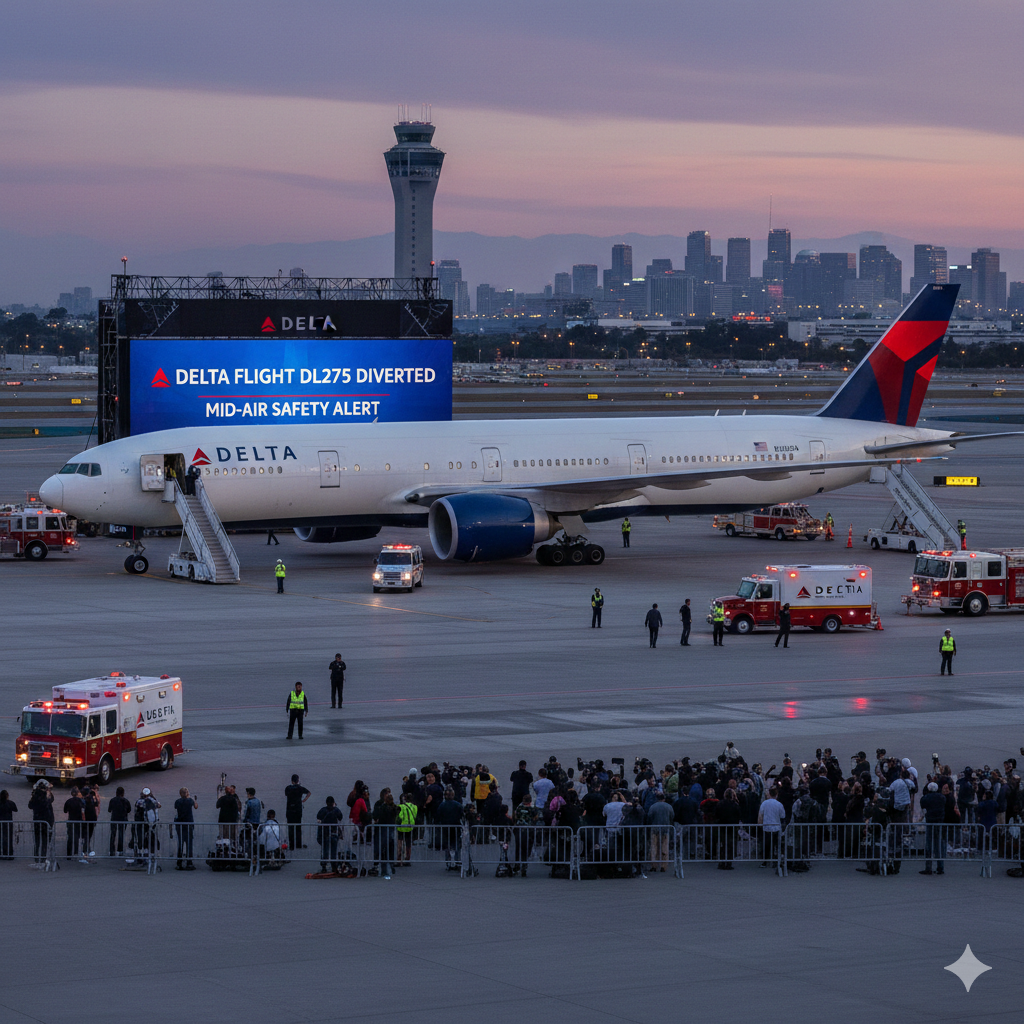
Late in May 2025, Delta Air Lines’ long‑haul Flight DL275, en route from Detroit to Tokyo, was forced to divert and land at Los Angeles International Airport (LAX) following a mid-air safety alert. Although the event created disruption, the measured response of the flight crew, along with advanced aircraft systems, helped prevent what could have become a far more serious situation. Here’s a full look at what happened, why LAX was chosen, how passengers reacted, and what this incident means for aviation safety.
Contents
What Happened A Timeline of Events
DL275 departed Detroit (DTW) on schedule, carrying hundreds of passengers on its transpacific journey. The aircraft was an Airbus A350‑900, powered by Rolls‑Royce Trent XWB engines. Everything appeared routine during the initial climb and early cruising.
However, about five hours into the flight, somewhere over the North Pacific or near Alaska, the crew began to receive warning indicators relating to the engine’s anti-ice system. According to multiple technical analyses, the system that prevents ice from building up on critical engine parts began behaving abnormally.
Recognizing the seriousness of such a failure especially while flying over isolated, freezing regions the pilots initiated precautionary procedures. They communicated with Delta’s Operations Control Center and declared their intention to divert.
Rather than continuing onward or attempting a landing at closer airports, the crew directed the aircraft toward LAX. The descent began, and DL275 landed safely on LAX’s Runway 06R in the early hours, where emergency services were standing by though no injuries were reported.
Why the Diversion Was Ordered: The Anti‑Ice System Failure
At high altitudes and over cold, moist air such as the routes over the northern Pacific engine anti-ice systems are critical. These systems use hot bleed air from the engine to prevent ice accumulation on components such as the inlet guide vanes and fan blades. If the system fails, ice can form, disrupting airflow, reducing thrust, and even risking engine damage.
In DL275’s case, reports indicate that sensor readings showed a drop in flow rate, temperature fluctuations, and possible valve malfunction or lag. These irregularities triggered cockpit alerts and forced the crew to follow a high-level emergency checklist. Given the critical nature of anti‑ice protection in such conditions, continuing the flight without functioning anti-ice capability carried unacceptable risk.
Although the A350 is equipped with redundancies and remains flyable with degraded systems, the pilots opted for the safest path: diverting to a major airport with the right infrastructure.
Why LAX Was Chosen as the Diversion Airport
One might wonder: why not divert to Anchorage or Seattle — airports that seem geographically closer? The decision to divert to LAX was driven by several strategic considerations:
- Maintenance Capability: LAX is a major Delta hub and has full maintenance facilities for the Airbus A350, including certified personnel for Rolls-Royce engines.
- Parts & Engineers Availability: With a complex system failure on the anti‑ice subsystem, having access to the right parts and specialized mechanics is crucial. LAX offered that immediate resource.
- Safety & Infrastructure: As a busy international airport, LAX has the necessary support fire & rescue teams, ground handling ready for such contingencies.
In short, LAX provided the optimal balance of proximity, technical capability, and safety infrastructure, making it the logical choice for a precautionary landing.
Passenger Experience: Calm, Communication, and Relief
As the diversion unfolded, the cabin crew played a key role in managing the atmosphere onboard. According to multiple accounts:
- The captain made announcements, informing passengers about a “technical precaution” and apologizing for the change in route.
- Flight attendants reassured travelers, maintained calm, and made sure people stayed hydrated and comfortable.
- No panic was reported; some passengers even expressed gratitude afterward for how professionally the crew handled the situation.
Once the aircraft landed at LAX, ground staff worked to deplane passengers safely, offer accommodations, meals, and rebook connections. While there was clearly inconvenience, many praised Delta’s transparency and care during the disruption.
Financial & Operational Impact
Diversions are costly — not only in fuel, but also in maintenance, passenger care, and schedule disruption. Analysts estimating the hit for DL275’s diversion suggest:
- Additional fuel burn due to rerouting
- Landing fees and handling at LAX
- Maintenance checks on the affected A350 and its engine
- Passenger costs, such as hotel stays, meals, and rebooking
- Opportunity cost, since the Tokyo leg of the flight was canceled or delayed, affecting Delta’s network and revenue
Some sources estimate the total financial impact to be in the low millions of dollars. Beyond the immediate cost, such unscheduled diversions also affect airline reputation, operational reliability, and possibly insurance and maintenance reserves.
Bigger Picture: Lessons for Aviation Safety
While DL275’s diversion was disruptive, it also highlights several important trends and lessons for the aviation industry.
1. Importance of Predictive Maintenance
One of the recurring themes in post‑incident analyses is the potential to detect such faults before they escalate, using advanced predictive maintenance tools. Machine learning models that analyze real-time engine data such as temperature, bleed-air pressure, valve behavior could flag degrading anti-ice system performance before a flight departs.
If such systems had detected the anomaly early, Delta could have carried out maintenance proactively, avoiding the risk, cost, and inconvenience of a mid-air diversion.
2. Redundancies and Clear Procedures Work
The Airbus A350’s built-in redundancies from its multiple monitoring sensors to the backup systems for critical engine functions likely prevented a more serious outcome. Combined with the crew’s disciplined response and Delta’s operational protocols, the situation was handled in a way that prioritized safety.
3. Role of Infrastructure in Emergency Decision-making
Choosing LAX as the diversion point underlines how crucial ground infrastructure is in emergency planning. An airport’s ability to handle large wide-body aircraft, carry critical spare parts, and host specialist engineers can make it the best option, even if it’s not the nearest geographically.
4. The Value of Transparency with Passengers
Passengers’ positive reactions to the crew’s communication and the airline’s handling of rebooking and care post‑landing show the value of transparency. When airlines clearly explain risks and plans — even amid uncertainty — it builds trust, which is vital for long-haul operations.
What’s Next?
After landing, DL275 underwent a detailed inspection. Reports say the anti-ice system issue was confirmed, and the aircraft remained grounded for approximately 18 hours while engineers worked to diagnose and repair the fault. Once cleared, the plane resumed service.
On the broader front, aviation experts believe that incidents like this will push airlines to more quickly adopt real-time monitoring and AI-based predictive maintenance. Regulatory bodies may also tighten requirements for data collection, system transparency, and fault prediction to further improve safety.
Conclusion
The diversion of Delta Flight DL275 to LAX after a mid-air safety alert was a serious event but not a catastrophe. Thanks to the vigilance of the flight crew, the resilience of modern aircraft systems, and the strategic decision to land at an airport with strong maintenance support, what could have turned into a severe emergency ended in a safe, controlled landing.
More importantly, the incident underscores how critical advanced monitoring and predictive tools are for aviation’s future. By learning from these episodes, airlines can reduce the risk of unplanned diversions, protect passengers, and save millions — all while reinforcing safety as the top priority in every flight.
